


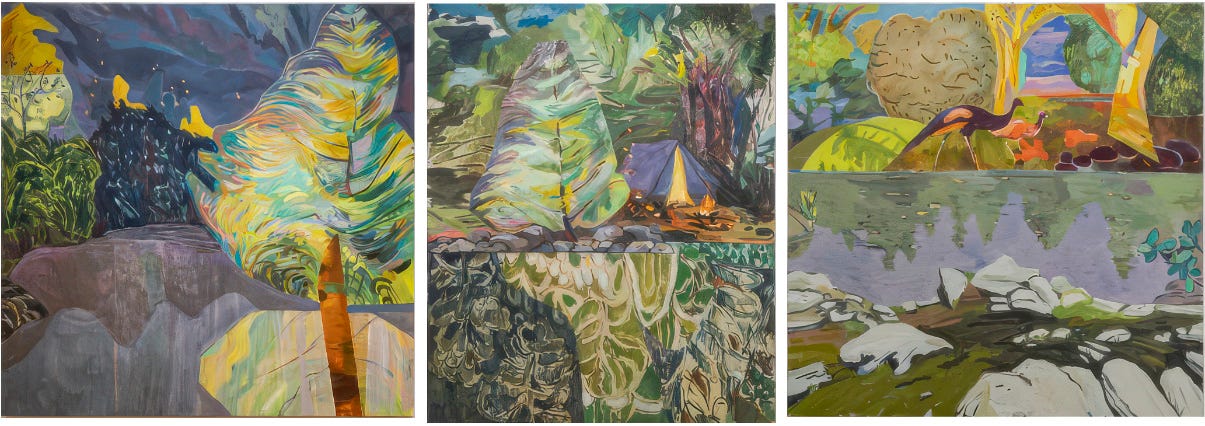
When I saw Windfall Light at the Art Gallery of Guelph, I wasn’t expecting to come away thinking about Glenn Gould, Alan Watts, Hafez, and the nature of time. I certainly wasn’t expecting Monica Tap to be the artist who would set all of that in motion.
On the second floor of the gallery, five of Tap’s paintings immediately caught my attention. I didn’t spontaneously recognize all of the references in them. I couldn’t have stood there and named every artist whose way of seeing had found its way into the paintings. And yet the work felt familiar. Familiar in the most pleasant way. I wanted to stay with it.
That feeling has stayed with me.

The exhibition itself was already circling many of the ideas that would later shape my thinking about Tap. Windfall Light takes its title from Dylan Thomas’s Fern Hill, evoking a summer landscape suspended in time: dappled golds and luminous greens, deepening warmth, undulating fields, birds and blossoms, and the awareness of a season already beginning to recede. The exhibition brings contemporary artists into conversation with works from the Art Gallery of Guelph’s collection, situating “time and transformation as relational and continuous”, the sun “born over and over”, while holding abundance and loss in delicate balance.
Perhaps I was already prepared to look at Tap’s paintings in that way.
Why did I feel that I already knew these paintings?
In a conversation about her work, she describes each painting as being made up of multiple images, impressions, memories, and sources. Her task, as she describes it, is to make these things cohere without allowing them entirely to lose their own personalities.
That seems important.
Much of the writing about Tap’s work emphasizes the artists who appear in her preliminary collages. She begins by cutting and arranging photocopies of paintings she loves, bringing together fragments of different painters and different ways of seeing. The names are there: Tom Thomson, Emily Carr, David Milne, and others. The art-historical references are fascinating, but I think they can also become a kind of red herring if we stop there.
Because the collage isn’t the painting.
The collage is a way of thinking.
Tap describes these preliminary constructions as a community of painters. She asks what happens when different visions are brought together on the same canvas. Can different ways of seeing coexist? What does that look like?
But there is another source here that is easy to overlook when we concentrate on the art-historical references: the landscape itself. Tap’s collages and paintings are rooted in the natural world around an off-grid cabin near the Pickerel River in Northern Ontario. The water, trees, darkness, reflections and shifting light aren’t simply subjects to be represented. They are places she has lived with and looked at over time.
So there are really several communities meeting in these paintings: the landscape itself, the painters who have taught her how to see it, and Tap’s own accumulated experience of looking. The historical references don’t replace the landscape. They become part of her way of seeing it.
I like the word community.
It suggests something quite different from quotation or appropriation. Tap isn’t standing outside art history, pointing to it. She enters the same space as those painters. She keeps them close.
She has said, “I’m setting up spaces where I’m trying to picture how the world looks to me when I look at it.”
Not how the world looks.
How the world looks to me when I look at it.
There is a subtle but important difference.
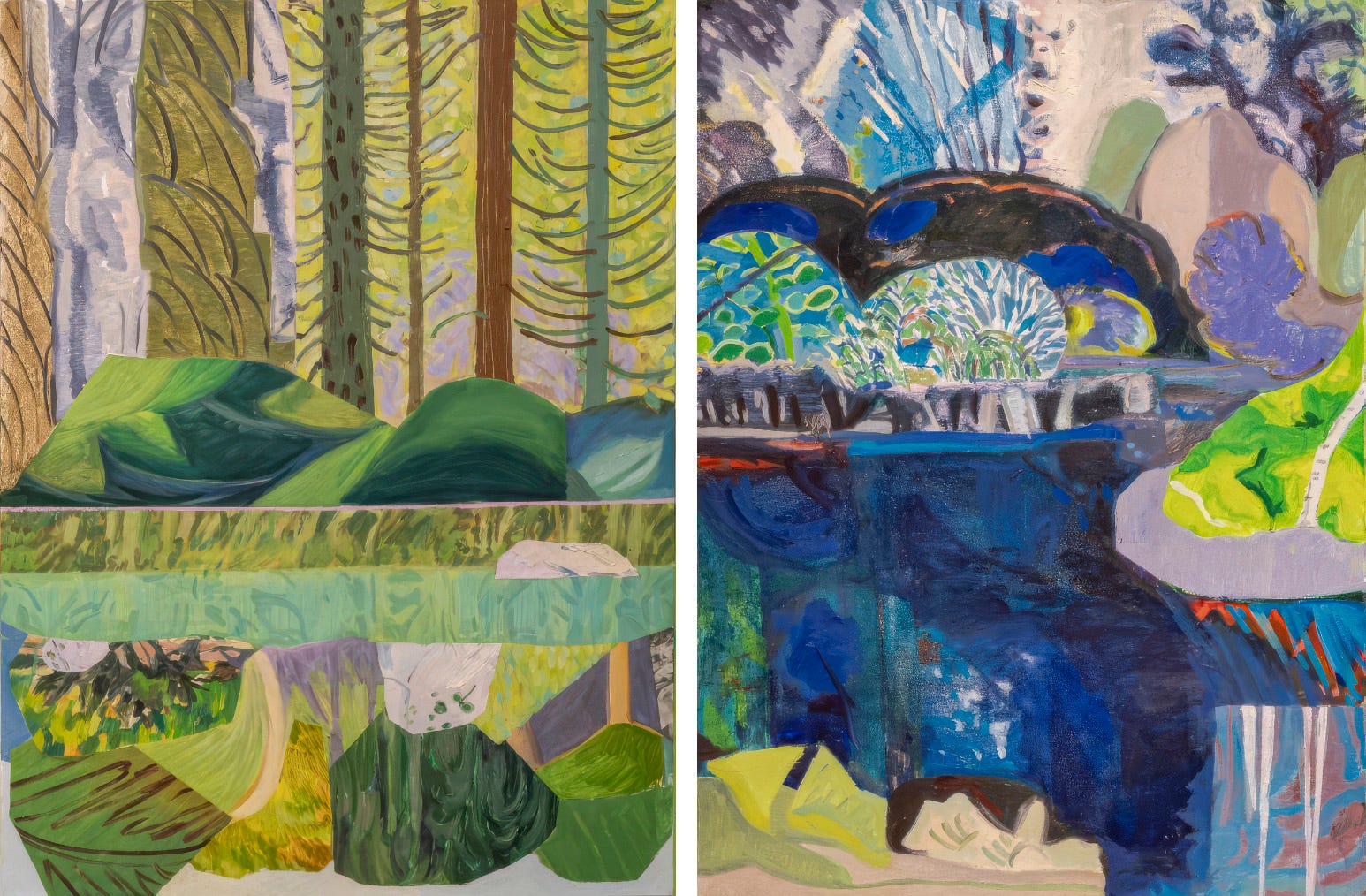
The painting isn’t simply a representation of a landscape. It is a constructed space in which looking happens. Memory, observation, imagination and the history of painting can occupy the same rectangle. Tap has repeatedly used a horizon line with a reflection that doesn’t necessarily reflect what is above it. She describes this as both a compositional problem and a way of opening the painting to different times and different spaces.
Above and below.
Observed and remembered.
Dream and reality.
Past and present.
All of them can occupy the same place.
Thinking about this, I was reminded of something I had recently read in Conversations with Glenn Gould. Jonathan Cott, talking to Gould about the question of tempo, describes it as a kind of container into which a liquid is poured. What interested Cott was not simply whether a piece was played quickly or slowly, but how the chosen tempo creates a field of tensions and relationships.
That metaphor stayed with me.
I began to see something similar happening in Tap’s paintings.
The colour planes, the horizon, the divisions of the canvas establish the container. Into that structure she pours the accumulated material of painting: the gestures, colours, memories and ways of seeing she has absorbed from other artists and from the landscapes that surround her.
But then she does something even more interesting.
She paints the collage.
The cut-and-pasted fragments disappear. They are no longer pieces of separate paintings. They have to be translated into paint, into a single surface, by a single hand.
The old distinctions begin to dissolve.
What moved me in Guelph was the opposite experience. I recognized the paintings before I recognized their sources. I knew them without knowing exactly why.
What moved me in Guelph was the opposite experience. I recognized the paintings before I recognized their sources. I knew them without knowing exactly why.
Perhaps that is because we don’t encounter landscapes innocently. We have been taught how to see them. Our eyes are crowded with other people’s eyes. A tree is never simply a tree once we have seen it through Emily Carr. A northern landscape carries Thomson. Water carries Milne. Light carries Lois Dodd. The history of landscape painting is already inside our looking.
Tap seems to acknowledge this rather than trying to escape it.
She once described her paintings as “twenty pairs of eyes trying to declare how they see the world and somehow be orchestrated together to come into some kind of agreement.”
I love the idea of the painting as an ensemble.
Not twenty painters competing for attention, but twenty ways of seeing finding a common key.
And perhaps this is where Glenn Gould comes back into the picture.

Gould’s great gift was not that he erased the composers he played. Quite the opposite. He listened so closely to the music that he could enter into its structures and discover relationships that became his own. He didn’t simply reproduce the past. He made it present again through his particular way of hearing.
Tap’s paintings seem to operate in a similar way.
She doesn’t need to distance herself from the painters who formed her vision in order to become an original painter. She brings them nearer. She listens to them. She lets their voices occupy the same space as her own.
There is something generous in that.
It also makes me think of a line from Hafez:
“Stay close to any sounds that make you glad you’re alive.”
Perhaps that is what we do with the things that matter to us. We stay close to them.
We stay close to the artists whose work changed the way we see. We stay close to certain landscapes. We stay close to memories. We stay close to the things that continue to make something stir.
Maybe influence isn’t always something we need to escape.
Maybe it is something we can live with.
Something we can keep close.
A few days after thinking about Tap, I was listening to an Alan Watts lecture about time. He was talking about the rhythm of waves, and how it differs from clock time. The waves keep their rhythm, but they aren’t marching anywhere. Their movement doesn’t count down the minutes or measure what remains. Watts called it “timeless time.”
I thought again about Tap’s paintings.
The phrase from Windfall Light, ”time and transformation as relational and continuous”, now seems almost like a description of what I had felt standing in front of those five paintings.
Different times were there, but they weren’t arranged chronologically.
The past wasn’t behind the present.
It was inside it.
A landscape painted a hundred years ago could coexist with a remembered landscape, an invented landscape, the physical landscape outside the gallery, and the landscape of my own looking.
Perhaps this is what Tap means when she says that the canvas can bring “a bunch of different times into that same rectangle or square.”
The painting becomes a place where time doesn’t have to march.
It can pool.
It can reflect something that isn’t above it.
It can hold a memory beside an observation, a historical painter beside a contemporary one, a familiar landscape beside one that has never existed.
And maybe this is partly why I wanted to stay with those paintings in Guelph.
They didn’t ask me to solve them.
They didn’t require me to identify every voice in the room.
They gave me somewhere to be.I think that is what I recognized.
Not a particular artist.
Not a particular quotation.
A way of looking.
A world assembled from many worlds, held together just long enough for them to become one.
I went to Guelph and found five paintings that felt strangely familiar.
I am still trying to understand why.
I think that is what I recognized.
Not a particular artist.
Not a particular quotation.
A way of looking.
A world assembled from many worlds, held together just long enough for them to become one.
I went to Guelph and found five paintings that felt strangely familiar.
I am still trying to understand why.
Perhaps the answer is that we recognize the things that have already entered us.
Perhaps we recognize the voices we have been carrying without knowing their names.
Or perhaps, sometimes, a painting simply sets up a space in which all the things we love can come close enough to speak to one another.
And we stay awhile to listen.
I was lucky enough to visit the AGG and see the Tap paintings you mentioned here. I completely agree when you say that you experienced the paintings before you recognised the source. Monica’s works seem to be an homage to memory, but rendered in a way only she can. But there are glimpses of a collective memory in it that makes one stand at stare. I enjoyed reading this piece, and your thoughts. Cheers.
What a beautiful piece of writing about Monica’s paintings which travel in and out of time and space so effortlessly.